Featured Post

Volunteer or Apply for Teacher Fellowship

Volunteer or Apply for Teacher Fellowship at Adharshila Learning Centre for the session 2017 – 18 Beginning October-2017 We ...

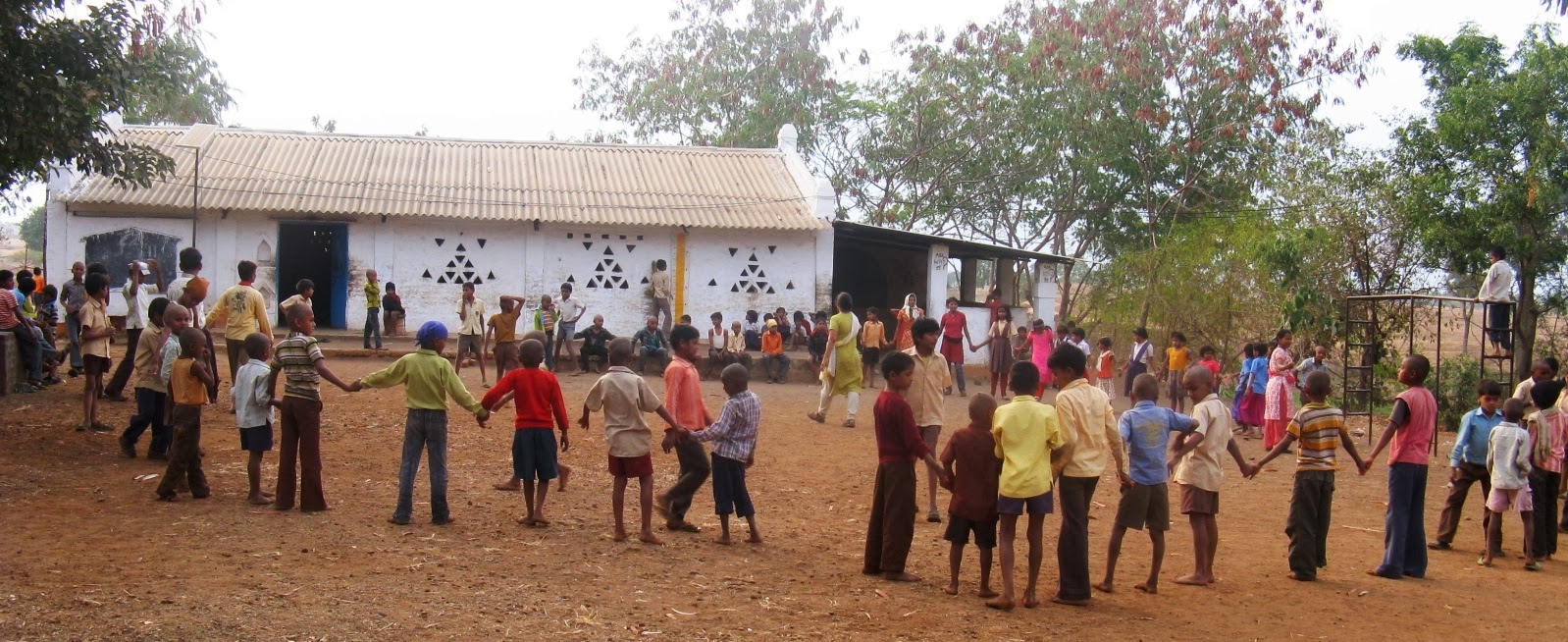
Adharshila Learning Centre is a unique school for adivasi children in Madhya Pradesh that views education as a tool for liberation...and a place of fun.

The Adharshila Learning Centre was started in 1998 by the Veer Khajiya Naik Manav Vikas Pratishthan.

The children have an active role in running the school.

Tuesday, December 30, 2008

Two Days With Eames Bhai

This post is about the visit of Eames Demetrios, a geographer at large.. He is a designer and also makes documentaries. The post has been written by children of Nile and Octopus groups at Adharshila - Imla, Chetana, Revali, Anil, Pushpendra, Sunil, Patidar, Madhosingh, Sarang, Mahesh, Krishna, Sunita, Suman, Lelsingh, Pavan.

On 16th November Eams Bhai came to our Learning Centre for two days from Los Angeles in North America. We met him for the first time. He came in a car from Indore.

He didn't speak Hindi. Eams Bhai spoke English very fast.

Eams Bhai brought pens and chocolates for us. On the first day he gave chocolates to children. The second day he gave pens to everybody. 'Eqlmundi Kirwela of Culev Larsze, Adharshila in Linear Sakad, MP. www.kcymearxphere.com ' - was engaved on the pens.

Eames Bhai told a long story in English which was translated for us by Amit Sir. The story was about Eqlmundi Kirwela of Culev Larsze. Eames Bhai had made this story. The story is based in South America and Adharshila.

The story is about an imaginary world called kcymearxphere. Culev Larsze rode on a saber toothed tiger. There was a brave girl named Segolin. Her pet lizard always sat on her shoulder.

In the story a tower was built in Sakad but later it was demolished. Culev Larsze goes to the Gods to stop the war between the believers and the non believers. The war was taking place in South America. The non believers were pushed to the Southern tip of S. America which was then separated by a sea by the Gods. But later on the war stopped due to Culev Larsze's intervention and every body was saved.

All the children liked the story. They were listening to the story very attentively. The story was very good.

Eams Bhai came to Adharshila to make it a part of his story, but he didn't write the whole story. To read further you have to go to the website - www.kcymearxphere.com.

On the second day he got five concrete slabs made in our Center. Three masons came from Sendhawa. All children helped in the work. Some children brought bricks, some concrete and others water and cement. Three slabs are on the boundary of the Center and two are in the middle. (The slabs represented the broken tower. )

He went to Sendhawa and bought oil paints for us. The children drew pictures of characters of the story on the slabs and Jaya Didi's house wall after listening to the story. They drew - Culev Larsze, Segolin, tower, lizard, bird, saber tooth tiger and the battle scene. Shewanta Didi and Dinesh Bhai wrote the story on the wall. First the children drew in their copies. When they showed the drawings to him he said, " awesome, coo(l)."

Eames Bhai had brought five cameras. He gave the camera to Ranjit Bhai, Prakash and Revali to take photos.

After the work finished all the children collected in the hall to sing and dance. Eams Bhai also came in the hall. He sang an English song - Boogie Woogie and the children danced to it. The children knew this song as some other visitors had taught them.

When Eames Bhai went back, all the children were sad.

Saturday, November 15, 2008

Organic Tomatoes and Shit in a Bucket

Post your summary here
What's on in Adharshila - Organic tomatoes, Election campaign, music group, Greeting cards, Shitting in a bucket...

So what are tomatoes doing in this blog ? these days many of us are working on the organic tomato/brinjal plot. Though due to my kidney stones i will not be able to eat any of this but it is great to wee them grow. The plants are almost two months old now. The best plant has about 60 tomatoes on it. We are feeding them Jeevamrit, mulch, ash and cow urine., and spraying pesticide made of five to six different types of leaves. We have been inspired by the Sharma farm near Amravati.
We have made three songs on elections. Some children have volunteered to go with the AMS who are trying to motivate people to focus on peoples issues and people's politics - whatever that may mean. The children will sing songs in the campaign. One of the songs is engineered on Vinay and Charul's song - mere voton ko ye jaanne ka hak re ... by the way we met them and heard them at a Narmada Andolan rally in Khandawa, where our Jamuna, Revali, Imla, Balsingh, Rakesh, Sarang and of course myself sang in front of a 25,000 strong audience. this was a first time performance for us and we are bent upon doing it again. the school kachaat band is in great josh and practices for two hours almost daily.
we have also got music and dance teachers who come every sunday - bothe bengali.
Children are making greeting cards again this year. Though cards are not in fashion but we insist on making them to keep the thumb from degenerating and to generate funds for our educational tour.
Shitting in the bucket - This is the latest. In an impromptu discussion in the tomato farm, this topic of uzing our shit for fertilizer came up. we have been thinking about this for a long time. but it was always on the lines of bio gas plants. We got books and a CD on dry latrines. This was all too technical for our primitive minds. Then i was reminded of a person in Maharshtra whome i had visited. He used to keep the bucket near his bed to emphasise the point that shit doesnt smell if covered properly. And i told this story to everybody and pat on.. Patidar and Sunil picked it up and promptly inaugerated the bucket toilet. it's been a week now. Inspired b this one volunteer from PRAVAH has also started digging a pit to shit in the bucket - quite poetic !

So long.
Amit

Tuesday, February 12, 2008

Shikshan Samwaad

Shikshan Samwaad
3rd – 4th – 5th March 2008
Adharshila Learning Centre
Venue : Village Sakad, P.O. : Chatli, Via Sendhawa, District Badwani, Madhya Pradesh.

Dear friends

This year the Adharshila Learning Centre is completing ten years. We started working with children after working in an adivasi organisation for about fifteen years. The main aim of starting this experimental journey, was to see, what role can education play in people’s struggles and movements for social and political change.

During our work in the sangathan we experienced that the educated section always stayed away from the struggle. Most of the time their role was to oppose the struggle and not just stand aloof. We realized that during the 12 – 15 years of schooling they learnt to look down upon their society and became totally alienated from their people and society. In these years the system teaches them to leave whatever is theirs - clothes, language, knowledge, values etc. and dawn a new attire – they are told that this is the way to become civilized. There are very few exceptions whose hearts and head remain in the right place even after long years of schooling.

Can anything different be done in education ? Can the youth while studying, or after studying, contribute to the work of social change or is the role of education only to help them join the mainstream ? And is this the only way out for the poor ? While starting Adharshila, there were many questions like these in our minds.

Should the peoples’ organizations concerns about the issues of education be limited to demands for making govt. schools run more efficiently and making the govt. system more strong? Or can we go beyond this and start thinking about strategies of transferring the thoughts and ideas born out of struggle, to the next generation ?

Every economic and political system designs an education system to serve it’s interests. What is the design for education of children in the minds of people / organisations who are engaged in struggles for a more just and equal society ? Can education play a role in realizing the dream of a just, humane and more egalitarian society, a new human being ? Or will the market eat up all the educated ?

We have organised a three day dialogue on education - Shikshan Samwaad – to understand, in depth, the linkages of education and social/political change and the emergent possibilities for groups involved in people’s struggles.

The sessions have been broadly divided in the following manner. This is not final. You can give suggestions as soon as you get this.

· The first day will go in understanding the viewpoint and work, regarding children and youth, of the various social/ political movements of the past, in India and elsewhere – Dalit, Gandhian, Socialist and the left movements. We are trying to call people involved in these movements or people who have studied these.

· The second and third days will be devoted to understanding, what role can education play in the long term struggle of social/ political change. In these sessions the main players will be the leaders of the various struggling groups/ organisations.

· If it is felt that there is a need to take up education as a proactive agenda, then the concluding sessions will be devoted to thinking of various strategies to do this and ways to deal with the various challenges that confront us in doing this.

So friends, come prepared to battle with questions related to education, for three days. You can bring documents, posters, pamphlets, books, films or anything which you would like to share with others.

We request and insist at the same time that you please take time off from your busy schedule for this dialogue, and spend time with us from 3rd to 5th March. We request you to reach here by 2nd evening. Feel free to inform and bring other interested people with you.

Please inform us by phone of email.

Adharshila Learning Centre, Badwani, M.P.
Adivasi Mukti Sangathan, Badwani, M.P.
Manthan Learning Centre, Rajasthan
Sobran Smruti Shikshapeeth, Jharkhand
Rani Kajal JeevanShala, Jhabua, M.P.
SRUTI, Delhi

Contact –
Jayashree – Amit at 09425981606 or email at adharshila.learningcentre@gmail.com

Arvind Anjum at 09431113667 Devendra – Sudhi at 09413103171
Bijoy - 09425364761 Kemat Singh – 09424005490
Rohit Jain – 011 26964946

Thursday, December 27, 2007

Children's Science Congress

PROJECT EXTRACT FOR NATIONAL CHILDREN’S SCIENCE CONGRESS

FROM FOOD INSECURITY ( MALNUTRITION)
TO
BIODIVERSITY --
A JOURNEY OF DISCOVERIES

(Under the Sub Title – Bio Diversity in Man made and Land Ecosystems )

Team : Suresh Dudve – Team Leader
Majali J.J.
Seetaram Dudve
Deewansingh Brahmane
Suresh Barole

The team was supported by almost 60 students of Adharshila Learning Centre, in the field surveys. In a sense the whole Centre was immersed in Bio Diversity.

Guide : Jayashree

Institution : Adharshila Learning Centre

Area of Study : Four villages namely – Sakad, Chatli, Kunjari and Merkhedi – of Newali Block, or Barwani district in western Madhya Pradesh. The district is a predominantly adivasi district ( 78%). It is situated in the Satpuda range bordering Maharashtra.

Importance and Relevance of the Topic

India is striving to stand amongst the leaders in the world community, but malnutrition is mocking us in the face. The fact that 40 – 45 % of the country’s children are malnutritioned is raising serious questions on the claims to development.Our strides in space are of no meaning if our children are malnutritioned, women are anemic. Something is gravely wrong somewhere.
Most children who have taken part in this project have suffered malnutrition in their childhood or seen there kith and kin die due to malnutrition. Majali’s eyesight is seriously impaired due to chronic Vitamin A deficiency during childhood. Malnutrition is very close to the hearts of the children.

Various surveys have shown that 58% - 60 % children of Madhya Pradesh are malnutritioned, much higher than the National average. Most of these are children of farmers and laborers.

The Journey of Discovery.

The study is based on the following sources –
Interviews of about 50 – 60 old people. Interviews of old people from outside the four villages were also recorded.
Household surveys in the four villages.
Books and journals were also used to understand the issues in depth.
We took advise from doctors, professors, organic farmers.
Some friends helped us search the internet. Due to electricity problems we could not do this ourselves.

Last year while learning about malnutrition and other health problems we surveyed the children of surrounding villages, taking their weights. We were shocked to see the extent of malnutrition. We saw children of 3 - 4 years who could not stand up. There were many children with Grade IV malnutrition. Many children from this group died after our survey. We reported this in papers and also to local officials.

On the 15th August we took a pledge to remove malnutrition and free the farms from market dependency. We used the opportunity of the Children’s Science Congress to go into the reasons of such wide spread malnutrition in our area, in depth.

We began by interviewing the old people of the villages to find out what they thought about the whole issue. About 50 old people were interviewed. Almost all of them were of the opinion that the quality of food had gone down in terms of quantity, quality and variety. They were the generation brought up on milk, ghee and curd. Even the poor in the village got a share of all this and at least pure butter milk was in abundance for everybody.

They also talked about the increased dependence on cash which was forcing everybody into cash crops and making farming totally dependent on the market. Farming which was once supposed to be an enterprise where - in people enjoyed independence, was now totally at the mercy of moneylenders and market prices.

They were convinced that due to the use of chemical fertilizers and hybrid seeds, which were promoted by Govt. agencies in the beginning, had led to loss of fertility of the soil.It was difficult for our young minds to digest what these old people were telling us. We were almost convinced that the adivasis of our area were going ahead on the development road – what about all the motorcycles, tractors, threshers, tube wells, pumps and irrigated fields, and quintals of cotton and soybean that we were selling by tractors, that we have been seeing since childhood ?

We undertook about 15 – 16 household surveys to validate these claims. A lot of food availability surveys were conducted. After these surveys we realized that behind the seeming prosperity there was severe food insecurity.

We found that -

There were about 120 types of food items which people ate of which now only 36 types were available. Most of the fruits, leafy vegetables, gums, honey, meat etc. available in the past have never been seen by the present generation. All these provided rare minerals, proteins, fats.
In most households only 7.14 kg pulses/person/year was available as against the required 22 – 27 kg/ person/ year( ICDS) .

Availability of milk and milk products had gone down drastically. Out of the 73% people who had got milk in there childhood only 17.39% are getting it now.

Where did all this vanish and why ?

We talked to people about this. About 40 years ago the govt. started promoting chemical fertilizers and hybrid seeds. The forests also started depleting about this time due to the pressure of urbanisation and population. Since then it has been a down slide. As dependency on the market increased people were forced to go in for cash crops. Cash crops meant loans at interests as high as 150%, dependency on the market, monoculture and depletion of the soil fertility. Before they realized people were in debt but started enjoying playing with cash. To repay loans more cash crops. This becomes a vicious cycle.

Also the mainstreaming pressure ( including our education system) forced the people to reject their traditional knowledge. They were made to lose faith in their knowledge systems and believe in the ideas being promoted by the market and Govt. agencies in tandem.

The main lesson that we learnt at the end of the exercise were that –

· Due to the depletion of farm and forest biodiversity about 54% of our food items have gone.
· Of the 65 items that we got now only 9 remain, i.e. an 87% decrease.
· Now 75% of our food items come from the farm.

These food crops are fast losing out to cash crops as market dependency is increasing in all aspects of our lives from clothes to health.

· Coarse grain and millets like bhadi which provided food security in droughts or scanty rainfall years are almost on the verge of vanishing.

· The quality of the soil has depleted, leading to loss of nutritional content of food.

· Cash crops now occupy the most fertile lands, leaving second grade land for food crops. Wheat is replacing traditional grains where irrigation's is there.

· The diversity in crops ensured that some crops will grow well in spite of changes in monsoons. Now with single crops occupying full fields the bad effects of erratic monsoons is more pronounced.

Conclusions

The loss of bio diversity has led to severe food insecurity. The quality, quantity and variety of food has decreased.
Adivasis and other small and marginal farmers are at the mercy of the market and dole provided by Govt. agencies.
If nothing is done then the future is bleak for farmers.

What is to be done ?

A strong campaign to save the farms from the clutches of the market and make the farmer independent, by promoting natural and organic farming techniques.

Fight malnutrition by making people aware about proper diet and importance of growing diverse food crops.

Awareness building programme in schools.

Incorporating related topics in the school curriculum.

Regenerate and save existing forest areas.

Re establish the self esteem of the farmer and adivasis. Revive useful traditional farming practices.


What we are doing ?

Natural farming on our campus.

School awareness programme.

Motivating families who have malnutritioned children to give special food preparations and grow vegetables. Children learnt to make sattoo and even gave it to many families.

Spreading the word through Baal – Melas.

Continue our research on this and related topics.

Motivate children and adults to adopt natural farming practices

Bio Diversity Project

Bio diversity Project selected to represent Madhya Pradesh in the National Children’s Science Congress


This is a first for us and all of us are very kicked about it. The science project submitted at the National Children’s Science Congress got selected to represent MP at the National Level conference. Right now the children are in Baramati, Maharashtra participating in the event.

As part of the Adharshila curriculum children do a lot of village surveys every year. One of the surveys done last year was to study the extent of malnutrition in surrounding villages.
This year we tried to go into the causes of such widespread malnutrition and we discovered that besides other things one of the main reason for this was the loss of bio-diversity in the area.
We submitted this report and vow ! the project got selected and now will be presented at the National Children’s Science Congress being held in Baramati, Maharashtra. The project was named – ‘ From Food Insecurity (malnutrition) to Bio-diversity – A Journey of Discovery ’

Another great thing is that this project has also been selected to be displayed at the National Science Congress at Vishakapattanam which is a conference of actual scientists (mainstream definition). This is a bigger honour because only one or two projects from each state are selected for this – projects which are of national importance and which researchers can pick up for furthur research.

About the project

About 50 elders were interviewed at first and asked questions related to farming practices, loans, quality of life etc. Invariably they said that the quality, quantity and variety of food has decreased now. They were the generation brought up on milk and fat( ghee) and now they lust to see even buttermilk, which they used to throw or give to cattle.

The main reasons for this decline, according to them were –

1. Depletion of forests and grazing grounds
2. Cash crops were replacing food crops.
3. Loss of nutrients in the soil

To check out what these oldies were saying, children did about 15 different types of surveys and found that most of what they were saying was true. Due to the pressure of cash economy farmers were forced to go in for cash crops which has resulted in loss of soil fertility, debt traps, suicides, loss of diversity in food crops etc. All this has resulted in chronic aneamia and malnutrition in children ( and women too) – the most vulnerable section of society.
The findings of the children are also corroborated by National Surveys where in we find that states famous for productivity and farming have high incidence of aneamia in women. Almost 50% – 60% children in Madhya Pradesh are underweight.

It was found that high chemical inputs, hybrid seeds and cash crops started started roughly 20 – 30 years ago ( which is roughly the time when the so called Green Revolution was introduced in our country ).

At the end of the study it was evident that eye catching and vote fetching social security schemes like anganwadis and mid day meals were not the solution to malnutrition. The solution lies at a deeper level of changing farm practices to non chemical and non market driven and market independent farming practices.

Side Effects

The children got a lot of exposure to whats happening in other ‘ big and good’ schools. Where many participants were son’s and daughters of teachers. How the world looks at tribals – poor, to be pitied, don’t know hindi, hey they are wearing clothes like us ! & Well you got selected only because you are tribals etc.

They just can't believe that these children have merit and they can be better than the best.

And this is what Adharshila Learning Centre is all about. To bring out the best in humanity


Wanted

……a GPRS enabled mobile to access internet in Adharshila.
Anybody discarding his/her old one is free to give it to Adharshila.
You can even loan it for some time, say six months or an year and have it back.

Wednesday, December 5, 2007

Math Vaato Insaan ko

We in Adharshila sing songs every day morning when we assemble for the school to start & also when we disperse. This is one of them. This song was composed about 18 years back by Vinay Mahajan. In the spirit & the hope for a secular future for our children..........

Math vaato Insaan ko


mandir masjid, girjadhar ne, vaat liya bhagwan ko
dharti vaati, sagar vaata, mat vaato Insaan ko

Hindu kehta mandir mera, mandir mera dhaam hai
Muslim kehta mecca mera, Allah ka imaan hai
dono ladte, lad lad marte, ladte ladte khatham huye
dono' ne ek duje pe na jane kya kya julam kiye
kiska he yeh maksad, kiski chaal chaal hai yeh jaan lo
dhart vaati.....

Neta ne satta ki khatir, komvaad se kaam liya
dharam ke thekedar se milkar logon ko nakaam kiya
bhai bante thukade-thukade mai neta ka hai imaan bada
vote mile aur neta jeeta shoshan ko adhaar mila
vakth naahi beeta hai ab bhi vakth ki kimat jaan lo
dhart vaati......

Prajatantre me praja ko loote, kaisi yeh sarkar hai
laati, goli, ishwar, allah yeh saare hathiyar hai
milke raho aur inse lado tum, inse ladna sheek lo
hakk hai tumhara chaiin se jeena, apne hakk ko jeeth lo
agar ho thang shaitani se tho, khatam karo shaitan ko
dharti vaati.......

desh ki janata bhook se marti dekho brastachar yeh
berojgari, tekedari, mahagai ki maar yeh
dharam, dharam chilane vaale, khoon bahayi desh me
shaitanano dere dale insaanonoko besh me
kaise kahenge saare jahan se accha hindustan ko
dharti vaati......

Tuesday, November 20, 2007

Invisible support cast

A member of the invisible support cast working really hard & helping us with this blog, installing the "read more code". Infact i met him through blogosphere, some similar musical interests. But it was just great for him to come over & help us, Thank you Manu.

He can be seen at http://www.codepencil.com/ & http://www.knowyourraga.com/