Featured Post

Volunteer or Apply for Teacher Fellowship

Volunteer or Apply for Teacher Fellowship at Adharshila Learning Centre for the session 2017 – 18 Beginning October-2017 We ...

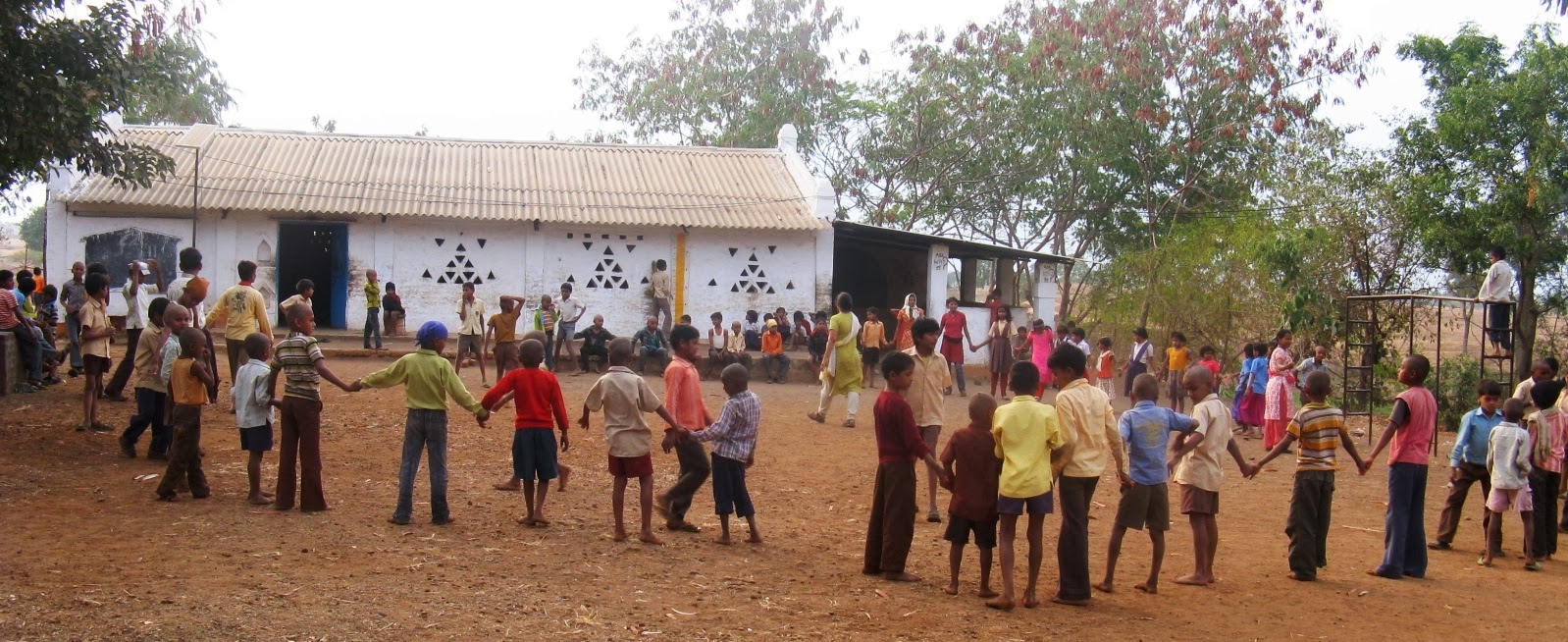
Adharshila Learning Centre is a unique school for adivasi children in Madhya Pradesh that views education as a tool for liberation...and a place of fun.

The Adharshila Learning Centre was started in 1998 by the Veer Khajiya Naik Manav Vikas Pratishthan.

The children have an active role in running the school.

Friday, March 15, 2013

The Veena player at Adharshila

I was happily sitting in a train bound to Kota when I got a call from Mr. Niranjan Haldar asking me when he can go to see the school ? Vow. Hardly anybody says this. Usually we are calling people to come over.

Aikla choulo re.....
 The next Saturday after much ghabrahat (usual in middle age men before a journey) we were in a bus to Sendhwa. I forgot to tell that Mr. Haldar or Haldar Sir, as he is popularly known in Indore, is a musician of great repute besides being a regular artist at the All India Radio. One of the few in India, definitely in Madhya Pradesh who play the Vichitra Veena, guitar and the synthesiser with equal ease. A true synthesis of the traditional and the modern. We got acquainted with him as our children learn music from him.


Reached Sendhwa by noon and from there to Adharshila in an auto-rickshaw, waiting for us at the bus stand. What luxury !

The children had a two hour session with him in the evening where he taught them the famous song - Aikla Choulo Re. Initially he was sceptical about teaching a Bengali song, that too Robindra Sangeet to adivasi children but the scepticism vanished in the first ten minutes seeing the ease with which the children picked up the lyrics as well as the tune. We helped them by writing the lyrics on the black-board.
Presenting the Haat calender to Mr. Haldaar


We were not so surprised as we had seen them pick up Marathi, Tamil and Chattisgarhi songs which earlier visitors had taught them.


It was great to hear the anthemic song, Aikla Choulo whispering out of the door and jaalis of the hall. How easy it is to be one... with total strangers. Of course music makes it so much easier. Listen to the music -
http://www.facebook.com/photo.php?v=428391290581649

Bareli folk, filmi and patriotic song session.
Prakaash, presenting a mud horse used in tribal ceremonies,
with Jayashree. .
Next day again we had a session with another song - the Hindi version of another Robindra Nath song - Anand loke mangala loke and later as we were chatting in our verandah there was an impromptu session of Filmi, Folk and Patriotic songs. The children, Haldar Sir on the harmonium, and visitors from Bangalore, students of Azim Premji Institute - were all in it together.

But there's always more ... especially when you are at Adharshila, the heart of rural and that too tribal India - there was no electricity when we reached. None at night and not the next day too ... No electricity means no water as it has to be pumped. But HS was quite sporting and was even ready to visit the field in typical rural style.. but fortunately there was some water in the drum. Teachers enjoy some privileges.

The cot under the million star sky always makes up for the inconveniences of the day. We too on our part made it up with the traditional tribal feast for guests - kookdi and kudri (chicken and rice).

Hope we have more interaction with him in the future.

Calender -2013 - Haats - Weekly Markets

Great things and VIPs always arrive a little late ...and always manage to make a place for themselves in the front rows! and then like the traffic guys keep reminding us - better late than never ! so...finally the Calender -2013 is out.....and finished.. all of the 1000 copies. The money raised will be used for Adharshila.


 It is based on the theme of rural weekly markets or haats - a vibrant place for economic and social exchange in rural areas. The word Haat seems to be derived from the word Haata/Saata which means to exchange goods in place of each other or barter, in the bhilali, bareli languages of the adivasis of western India.

It seems there are about 47000 haats in India which come alive everyday with farmers, artisans and small traders living in the remotest of places. Everyday after the dust and noise of laughter, bargaining and fights, the market falls silent only to be resurrected the next day at some other place. People gather and disperse and trade worth crores happens without any middlemen. 
Who needs retail chains ?


Haats are democratic markets where producers sell their ware directly to consumers. Baskets, pots, vegetables, seeds, cloth.... anything.

People converge at the Haats not just to buy and sell but also to meet relatives, friends, a daughter married in a distant village, resolve feuds and for many other social reasons.

Thursday, January 17, 2013

Naatak India Company

Naatak India Company - the theater group of the children of Adharshila is going strong this year. This year's new production - 'Bhanai' is a play based on the state of education in rural areas. The play has been staged in 5 places in Madhya Pradesh and Gujarat in the last 3 months and has been performed by one group in Shahdol - district of MP.

Father and Son fighting after the son fails to get a job and wants to set up a liquour shop.
About the play
The play shows how the dreams and aspirations of the adivasis and the lofty ideals of the constitution and the post independence leaders are betrayed by the education system. It has hilarious scenes of stereotypical Govt. schools in villages. The teacher holds the play and sends the audience in fits of laughter. The second part of the play shows a TV panel discussion with the minister about the abysmal condition of Govt. schools where he proposes that privatization is the only alternative. The panelists refute these suggestions based on their experiences with private services in health and transport. The play ends with exhorting the parents to take a more pro-active role in improving the schools and to protest against privatization of education. The best part of the play is that it brings out the education scenario in a very entertaining manner.

The play has been written by Amit with expert comments from Jayashree.

We were lucky to have Avijit and Aakash to help in the rehearsals, sets and costumes for the first performance. The play was staged first at the State Convention of the Indian Peoples Theatre Association at Indore in October 2012. After that it was staged at Jan Vikas, Indore, Adviasi Sammelan - Palsud, District Barwani, Adharshila Learning Centre and National Adivasi Mahasammelan, Sagbaara - Gujarat.

We are game for going anywhere to stage the play, provided the hosts bear the costs of travel, hospitality and honorarium!

Have a look at the some photos of the this and other plays at -
http://www.facebook.com/NaatakIndiaCompany

Thursday, November 1, 2012

Math on the Farm

As I started listing the Math activities that we have done on the campus, I reached 50 topics very fast. Here's one.

We wanted to figure out the per acre yield of vegetables on our Center's organic farm. So with great enthu I took the Amazon and Nile group children ( Age 12 -14, roughly 6th and 7th grade) on the farm. This I explained to them and after a frantic search of the campus and inquiring from the adults we were able to find  ropes and an old steel tape, left on the campus by a mason. Children divided themselves in groups for various vegetable plots viz. kaddoo - pumpkin  lauki- bottle gourd, gilki - gourd, bhindi - ladyfinger and chavli.- beans. 

It started on a good note as most children knew that to calculate the area we need length and breadth of a rectangle. Discovery 1 - the plots were rectangles. But one was not. It was a trapezium. This group had to struggle the most. Later on the groups also struggled with this problem in the class. This stage of measuring and multiplying to get the area of the plot was fairly easy. The main problems were like how to write 34 meters and 50 cm. in decimal form and add ? Should we write 34.5 cm or 34.5 m ? After multiplying, how to write the answer - 214.65 m/cm or sq. m. ?
And one more thing - the steel tape was broken. Its marking started at 30 cm. It took some time to figure out that the meter that we were measuring was actually just 70 cm. Also it was easier to measure with a stick  rather than a rope, that I had suggested.

The next steps were very sticky. Firstly we had to convert the square meters to gunthaas - the measure used by organic farmers around us - especially those associated with Dabholkar and the 40 guntha experiment. One guntha is 100 sq.m. for this conversion children had to go back to the 5th class problems eg. 5 pencils cost 10 rupees so what is the cost of one pencil. Sounds easy but with numbers like 259.78 sq. m it looks impossible to children. Any way once one or two smart guys had done it they taught the others. They learnt this after doing similar simpler problems ( at least at that time they did it. Actually I cant say that they learnt it). Then they had see the mess register and figure out the total amount of vegetables produced and find out the production per guntha. And finally the production that would happen on one acre. One acre is 40 gunthaas

After toiling for two - three hours one group got the result. The other groups got frustrated and left it. They tried it the next day with help from a senior who teaches them maths.

The best part of all this was the result. The realization that we had produced quite a lot. Though we have to check the record productions for veges but the figures were pretty high for us, considering that we started from a totally barren peice of land. Most of the veges. went to about 20 quintals ( 2000 Kg./acre). The pumpkins were about 40 quintal an acre. Costed at Rs. 20/ kg this means Rs. 40,000/acre which is very good income as compared to other crops( not counting the marketing problems).

All the children were wide eyed and didnt believe their answers. Anyway it led to a discussion with the elder children about the usefulness of the school syllabus which does'nt teach to earn from their own resources. We are able to produce veges for the school mess - 120 children and adults - enough for 3-4 months. How we wish that some children opt to learn this instead of blindly following the school under societal pressure. Maybe someday...someone....

http://www.facebook.com/adharshila.learningcentre

Friday, October 5, 2012

Naatak India Company has a page on fb

Inspired by our success of the play 'Bhanai' in Indore, we have created a page on fb. The idea is to show the work of the Naatak India Company - our theatre group.
But not just this.
We also want to get in touch with other theatre people/ groups who can help take this work forward.
Like most of our other ventures the Naatak India Company is not a funded venture. We want to take it fwd. with the help of friends as volunteers and through the funds generated through the shows. Only if some people want to work on it on a full time basis, we will look for their fellowship support.

Though the page is new please like it and link it your blogs, accounts, etc.

Thanks

Tuesday, July 3, 2012

Adharshila - We're on - 2012 -13

The new session of  2012 -13 at Adharshila. Its on. About 80 parents turned up at the new admission meeting on 25th June. 60 new aspirants have registered. Lets see how many turn up.

The enthusiasm is less as there are'nt any rains as yet. Its difficult, going to be more difficult. For the animals its going to be really bad. If you are a farmer you do'nt have to be a crystal ball reader to see the future year, sitting on dry land with no clouds. Just wind.

The uncertainty of agriculture is a real reason for people wanting to get their children to schools. The only link of schooling is with jobs. But the kind of education being dished out in rural schools, mostly in steel plates at the time of mid day meals, is the main reason for the lack of interest in schools. If you can afford it - the option is pvt. school if not wait for being 14 or 12 or whatever to go to a ginning factory when you can start earning. Till then small chores at home - tending goats, farm, this that, fun....

We too wait... for children, friends, volunteers, fee, donations, something to happen .. rain.

With all kinds of theories in the head, contradicting each other, principles and practicalities we are still at it   (" i still love you" our daughter tells us like a cuckoo clock)...

We cant let the dryness dry our spirits. Majali, Shewanta, Shanta and Badri bhai are at it. Running after the crane to pull out the tubewell, then to put it back, out again, more pipes, electricity, decorating the rooms, fodder for the cattle, talking to parents, entertaining the children, bargaining with the cooks...

....... living up to promises and the sparkle in the eyes of the newcomers.
Thats it. We can't dissappoint them.