…It is 3:00 of a sunny afternoon and wandering through Papita Hamlet, I find my way to Mullya’s hut, where kids are hooked with sheets of paper folding them into origami birds, boxes, and stars, which they hang from the ceiling. After he gives me some cool water, I move on to the Boyda Hamlet, where Sanjay gives me a tour- their house is under construction. He shows me the small enclosure they had just built for one of the new mother dogs and her puppies. We hang out in his neighbor Suklal’s house where he is copying song lyrics in his notebook, and begin to sing out the songs.
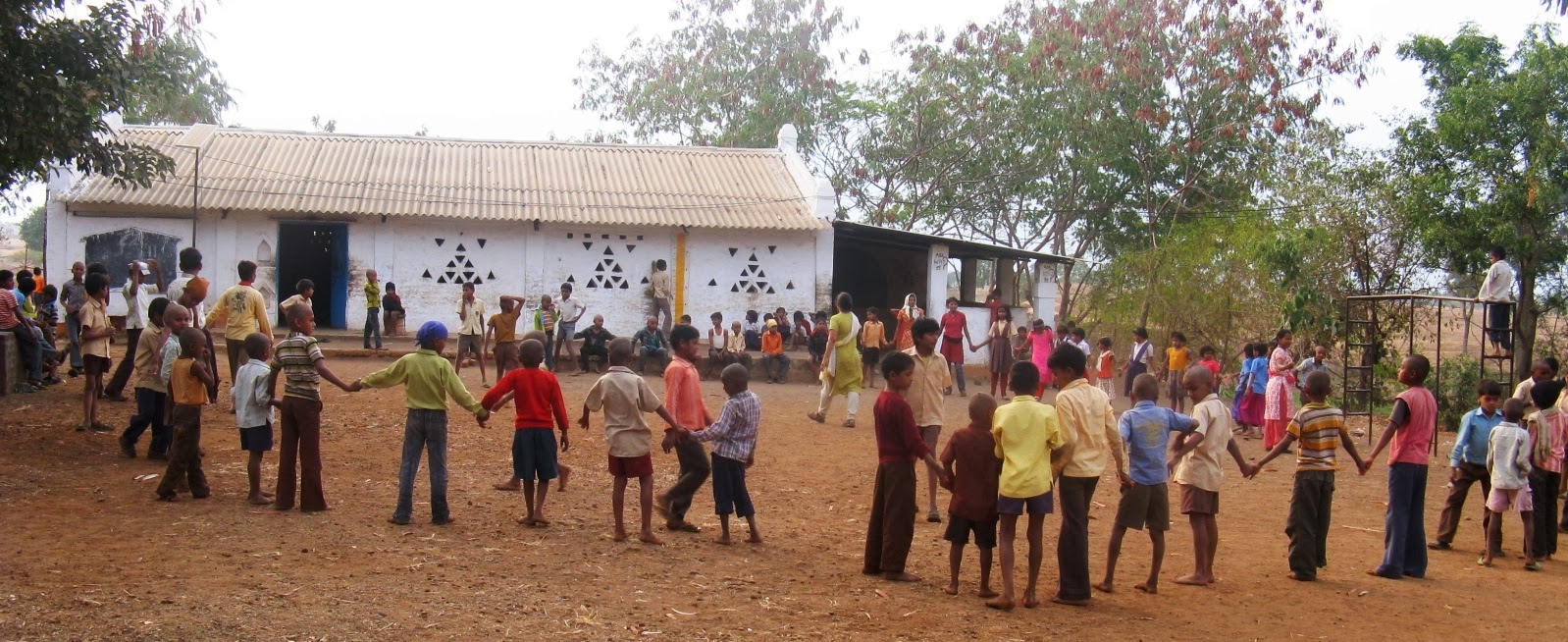
Adharshila is abuzz with energy. Very hectic activity. It starts at eight in the morning and children have to be dragged out at five or six in the evening. Since the last three weeks children are fully engaged, making small box like rooms for themselves, from anything they can lay their hands on – twigs, gunny bags, plastic, cloth, ropes, old anything.
They are sitting there, eating there, playing, chatting, reading and writing also, drawing. But mainly they are building the room, already repairing, rebuilding, changing location, decorating and going around.
It started as a joke but now it’s full time. Kids often play ‘make-believe’ which mimics reality. But this has everything to do with reality- the kids have brought in water pots for cool water, clothes washing spaces with drainage, a common open space with park-like benches, and racks for books, clotheslines, curtains, and small brick enclosed verandahs. A dry latrine is under construction. Outside one of the homes, a Subabool sapling and aloe vera plant have been planted and being drip irrigated (an overhung plastic bag filled with water with a small hole). A chalkboard with the school chants and all of the residents’ names is posted. As soon as the the kids heard a story of a boy in Africa who brought electricity to his home and village making a wind mill out of waste they started to ‘make current’ from gobar (dung). No two houses are the same and there is a steady flow of visitors to one another’s houses. There are three hamlets- Tower, Papita (papayya), and Boyda (hill)- with 2-5 houses in each hamlet and 4-5 students in each house. In all about 40 children are involved in this.
But…… everything is not happy, happy. There are fights – someone broke someone’s hut, hey you took my sticks or gunny bag, someone forcefully made a hut ….and so on. Also there’s been damage to public property …. as at least two new upcoming trees were broken, hedges were broken, new bricks were taken for construction, one almirah and the basement were ransacked for material ..
So …
...there was a meeting to frame rules ( of course we exercised our authority). Everybody had a say and about 20 rules were made – not to break new branches, enter with permission, elders not to bully small children, clean surroundings of hut etc.
Sounds like a lovely picture but there are some apprehensions and resistance from the teachers as well as senior students. One day the teachers were very upset as nobody turned in for ‘school’. They pulled out everybody from the huts and sent them to class
For the teacher, the question lies in how to do the ‘school’ stuff when all the students have gone off in different directions, each doing a different thing. Before the the establishment of this children’s village, the bell-guided school structure was set- morning prayer, class, breakfast, class, lunch, class, …. One thing that was done was to get rid of the class bell, as it went against the students’ flow of work in their new spaces. Again, there was opposition to this, but the question remained… how to add the school stuff in the context of what the students themselves created?
So we had a meeting to explain the importance of this activity and generate ideas on how to incorporate ‘ learning of subjects’….
We tried to tell them that this the best possible thing that can happen where children are doing something continuously for 12 hours, without being told anything. There must be something in this. We should think how this initiative can be extended to what we call studying or learning.
We explained that the biggest learning that’s happening now and which could never have happened inspite of our best efforts was that children were learning to use freedom creatively, decide what they want to do and pursue their ideas without anyone telling them to. They were learning self discipline. And if one is so keen on learning then they were learning real life the settling of villages.
This was all right they said but what about english, maths, science etc. what will happen to all that we have planned for them ? so we made some exercises –
For teachers –
- Go by their (children’s) plan for a while.
- Go to their huts and record what they are doing.
For children –
English excercises --- 1. Where do you live?
2. Who lives in your house?
3. When did you build your house?
4. What is your house made of?
5. What is in your house?
6. What are the names of trees by your house?
7. What are you doing?
8. What are you doing in the hut ?
Activities --- 1. Survey the village and the hamlets and make a list. Find out who lives where, the number of people in each house and total the number of residents.
2. Make a map of the village.
3. Plant a medicinal tree by your house.
Maths --- 1. Take measurements of your house, find it’s area.
2. Levels worksheets that students do them independently and move up as they successfully complete a level.
Each of these activities were written on a card and the children were free to take a card and do it anytime they wished to. On completing a card they had to show to the teacher who would correct it and put a tick mark on her list.
The students have been continuously and independently beautifying and ideating for a month now, everyday, along with the rest of the school activities- cooking, farming, theatre, singing. And the reading and writing is alive and well, as the houses are a favorite place for quiet (and uninterrupted by bells & teachers) study. They read, sing songs, make lists, tell stories, play cards, sleep, eat... the list goes on…
… I’ve heard that the physical environment is a major conditioner of behaviour. From observing and interacting with the children and their spaces it is evident that the kids hold a sense of ownership over their house, their work, their days. Hopefully this will help them take control of their lives in adulthood. One thing that can be surely seen is the drive they have in this new project, and there is potential for much more…..
On a Monday the teachers forgot all the meetings and rang the bell. Collected all the children in the ground and … go to class!!
Some children didn’t go. They were tucked in their new houses. They didn’t even go to class. Again meeting, reminding.
Now a bargain has been arrived at. Some time the children have to go to their level groups in English and Math. Sometimes they just sit and do whatever they want. Some time they are given activity cards and they can choose to do them whenever they want to. We are creating more spaces and activities so that they can go to them. For eg. There are two boxes with books, an almirah with some games. Children just go there, take out things on their own and keep playing or reading. We are trying to create more of these self service counters.
Problems
- Some children become just wanderers and lost. It may be fine by us but not for parents.
- Some just ape others. Not neccesarily thinking on their own.
- The look of the school is very disorganised. The parents and visitors don’t like this.
- The parents have a set idea and no exposure to innovative or alternative learning methods leave alone curriculum.
- The children if questioned threateningly by parents or elders, just say that we are not taught. They don’t know the theory and merit of self learning.
- Ultimately the children have to give exams so they have to ‘study’.
We are sure that this is a good thing and will continue with bargains. This concept has generated a totally new concept of a learning within a school environment and we are now working out a different architectural concept for this approach.
Anyone with an idea interested in coming and working with the students? Calling engineers, architects, artists, musicians, teachers…



 One of our bulls was not well. He had stopped eating. Now he is allright and is grazing. The other bull banged his horns into the cow’s head (his mother), breaking a horn. This led to much consternation as the cow is due to deliver in a month.


