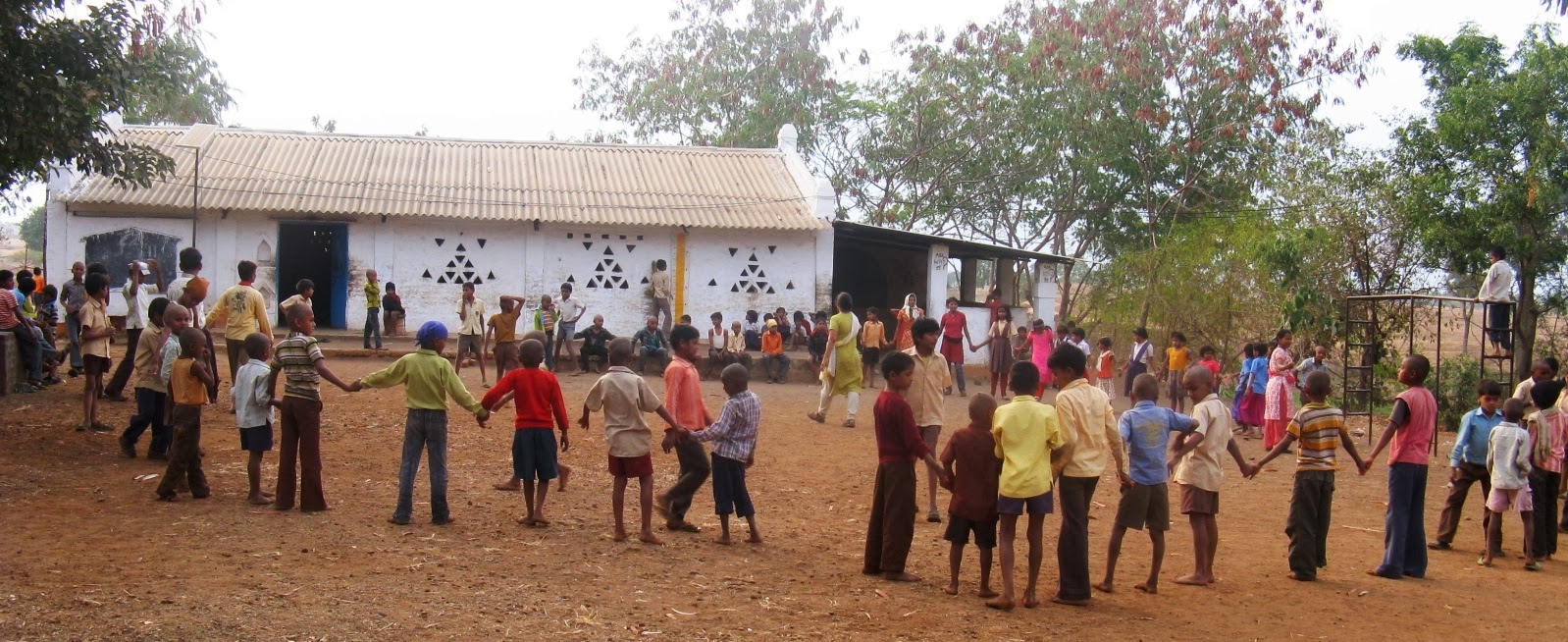
It is always a pleasure to share what happened at Adharshila with friends. So here it is. sorry it is only in English right now.
Adharshila Learning Centre
2009 - 2010
Annual Report
run by
Jayashree, Amit, Badribhai, Devika behen, Shobharam Sir, Majali, Shewanta, Shanta – the regulars
Kamal, Suresh, Prakash, Jamuna, Dharmalata, Imla, Rakesh, Patidaar, Mahesh, Krishna – senior students
The Octopus and Nile group children
Manasi, Preeyanka, Roshan, Amit, - the volunteers
Veer Khajiya Naik Manav Vikas Pratishthan
Dear friends
Thanks to your support and the hardwork put in by the children and team, Adharshila completed it’s twelfth year.
The world of school education has been set on the path of far reaching changes.
On the one hand there is increasing awareness about the shortcomings of the existing school system amongst the middle and elite class. This has led to more and more people searching for alternatives within and outside the school system.
The Govt. on its part is trying to change the statistics of literacy and school going children and has brought in the Free and Compulsory Education Act. It is also trying to shed off its own responsibilty to give good education to these children and wants to put it in the lap of private sector and NGOs. It is trying to do more of the same without recognizing that this school system has failed us. We need to think more creatively than this.
The most dangerous thing is happening, as usual, in the villages where a whole generation is being misled by the false promise of prosperity that schooling will bring. It is well known that only 2% children, of those enrolled in the 1st, pass the 12th class. The schools are creating an army of youngsters who want quick money. If we look at this fact in conjunction with the trend of farm land getting converted to real estate, and being bought by city people, forced schooling almost looks like a designed strategy for land grab.
Cynicists! You will say. Always looking at the negative side. Well reality is grim. It may not look so from where we sit, comfortable.
We strongly think the discussion on education should go beyond schools, rules, shams and acts. It is a time to revisit the basics of education – the meaning of the word, the aims, the ideals. Also the link of education with creating opportunities for not just livelihoods but living honest and dignified lives. And lastly to create citizens for an India, a society, a nation envisaged in the constitution - …. Democratic, Secular, Equal, Just, Socialist ( removed from the Preamble without any public debate)…
Adharshila is an attempt to understand the nitty gritty of edcuation, from the child to the curriculum, the ideals and issues and search for alternative ways of learning – theatre, singing, walks, schools with class and classless schools.
We don’t contend to have got the magic wand. But the effort has been honest and. We have some learnings. Others can use them too if they are interested, but we don’t insist…
Happy reading.
Amit and Jayashree
For The Adharshila Team
The monsoon triggeres it. Hope and enthusiasm. Absolutely no scope for depression and negative thoughts. Yes this is the beginning. Remember life began with water. The rain greens the brownest patch. We are convinced, rain induces chemical changes in the brain – the smell, temperature, humidity – everything, triggers the adrenaline, which gives the mood and energy needed to engage in hard physical labor for an activity as risky as rain fed agriculture.
About 85 parents, read fathers, turned up seeking new admission for their wards, mostly sons. Many others came later. School is after the farm. We had a record 80 names in the waiting list and the yearly itch to start a new school, but no takers.
My brother’s family is coming here en-route Leh from Kanyakumari. We can’t let them see this mess. So cleaning, cleaning, cleaning, new bed sheets, groceries and at the eleventh hour we welcome them in clean clothes as if nothing happened. And already there is Roshan, the volunteer from US, actually Dubai, Maraike from Germany and Vipin from Bangalore to spend some time teaching adivasi kids before going for his Masters at Princeton – an impressive guest list. Raju, an Oriya MSW, whose enthu for digging (rings around trees to catch water) is infectious. I am cured of the infection in three days.
The monsoon was on time, and as soon as the children came they got engrossed in planting vegetables, trees and pulses. They also started making their own vegetable plots where ever they found place. They are divided in groups according to their learning levels – Beej, Yamuna, Kaveri, Brahmputra, Fifth, Amazon, Nile – combined, Octopus – eighth and the elders giving 10th from Open School. In all we are 110 staying here now, including the teachers. And the works start with songs, games and flower beds. The rush of photocopying primers prepared at Adharshila in the local language – Bareli; cleaning of rooms, vegetable plots for groups, lots of planning and changing plans everyday, confusions, tempers, bringing order to the Mess, complicated time tables of hundreds of things ranging from classes, student teachers, and duties to cook, look after the five animals, cleaning, making porridge on the Uganda Choolah – latest addition to the kitchen – thanks to Roshan’s research, Shakeel bhai’s luhari and Jayahree’s motivation and of course the 8th -10th children. It was efficient as it used only half the wood.
The savings were used to get milk for the mess. This lasted for about six months. The savings stopped but the milk continued.
Finally we are settled. Oh! More visitors from US. Hey is it the recession ? Maybe there is something to it. A team of NRI students comes to stay with us for four days. They were brought by an organisation called INSPIRE. We pushed them into making English lessons based on local topics with the help of children. One group even made a slide show of the lesson. Pascale, a French sculptress stayed with us for a week and made a bust of the legendary adivasi fighter – Tantiya Bheel. Two volunteers from Pravah, Sameer and Rakesh stayed for a month and took drawing classes. They also left their mark on the walls of Adharshila. Karishma and Shraddha, also NRIs, wandering in India seeing alternative education experiments stayed for a week and developed an English story with the children. The principal and staff of a local school and friends from Sendhawa too came to look us up. An old friend Bhupendrabhai brought a group of dedicated people running a school for adivasi children, in South Gujarat.
Besides chatting with so many different types of people and learning about their countries, concerns and professions the children prepared songs, plays and skits for the Independence Day function where the village Dai – Lohangya Bai, who has delivered two generations of Sakad village was called to hoist the flag to emphasize the importance of traditional knowledge. Ironically this year her daughter in law went to the hospital with the Asha worker, who has no experience of deliveries, just so that she could get the money given as incentive to go to hospitals for deliveries. ( preparing for privatization of health). We also celebrate 15th August as the tree planting day. The parents plant at least 5 trees on the campus. Actually for the whole of the first two months tree planting and water conservation around trees is a major activity, besides farming. This year Kamal, one of the senior most students took charge of the tree plot – anjanwada. He looked after the tree plot which has about 200 trees, very diligently.
We also helped the Jagrut Adivasi Dalit Sangathan to start a new school, Azaadi Shikshan Kendra, in a very remote village in the Pati block of our district. For us this was very inspiring as this is something we have been wanting to do more. Majali and Neela, teachers from Adharshila stayed there for a week to help them set up. Later two boys went to help them with the preparation of their inaugural function. We did a one day teacher training for the Primary teachers of Kasturba Girls School, Newali in our tehsil. This is a very old Gandhian centre. We were honored by the visit of its dedicated leader –Pushpa Behen. We also conducted a teacher training workshop for the Rani Kajal Shikshan Kendra in Kakrana, Alirajpur district. The children conducted a Baal Mela for the kids. This was done twice in the year.
Interesting projects that went on for the full year was participating in a research project. Alf, a researcher from Norway is writing a book on the Khedut Mazdoor Chetana Sangath, for his post doctoral research. This is the same KMCS where we were working before setting up home in Sakad. We convinced him to involve the senior students in the research project and in the process teach them the research methodology. In the end Alf became a very good friend and Majali, Shewanta, Suresh and Prakash did most of the 40 -50 interviews and Alf was very impressed with the quality of questions and the interviews. He also agreed to help in printing small booklets based on the interviews. We even intend to make small films from the interview recordings. He also entertained us by playing the guitar. The children and people in Sendhawa stared endlessly at his long, golden tresses.
The first term ended in September with the Bhutta Khane Ki Chutti – a unique feature of Adharshila. This is a special vacation for the children to go home and enjoy the fruits of the farm – corn, beans, etc.
As the term was ending we welcomed two volunteers from Indicor who helped us over the year in teaching English and Math to senior classes. One of them Mansi is still with us where as Preeyanki left towards the end of the year.
Another volunteer, Apeksha, from Pravah was with us for three months and helped in documenting the science projects of the primary groups.
After many years finally a team from Eklavya came to Adharshila to do science experiments with the children. They more than compensated for all the years of absence by conducting four workshops. Actually they were also testing their modules. On the side we used to get delicious Indori Chiwada. The children really liked these workshops as they got to see and handle scientific instruments and material for the first time.
There were many other workshops conducted for the children this year. Nishi from Mumbai conducted a personality development workshop through theatre, Mukesh and Rizwana, Docufilm makers from Indore conducted a theatre workshop and made a play on Tantiya Mama, a Media workshop by Roshan, and a film making workshop by Kavita from Drishti, Ahmedabad. Sant from CEHAT, Barwani, an organisation working for health rights, conducted a two day workshop on primary health and health issues. He told the students about various health schemes of the Govt. There was an in-house art workshop for smaller children. Piyush from Srishti Art School, Bangalore, worked with children for a week to create illustrations for a Bareli alphabet song. Anna, Jayashree’s father trained children to make Aakaashkandils as part of the Diwali celebrations.
The greatest thing is that these were conducted voluntarily by these friends. This is a big thing for us because it is an example that if we work outside the project and market mode we do get very good people to help us. Life and good things are possible without money. Vow!
Many interesting class projects were done, based on diverse themes – rivers, trees, insects, bio diversity, health, body and immunity, HIV, animals, cities, Independence movement, book making, comparison of local dialects. An energy project was done to figure out the energy needs of Adharshila, ways of reducing it and figuring out ways of creating energy in-house.
This year we were part of an Indo – German children’s learning project, thanks to Katha and the Tara Trust, Goa, of which she is a part. The children of the German school sent drawings depicting their lives, interests and what they had learnt about India. Through these drawing our children of Kaveri and Brahmaputra groups learnt about them. They responded by sending drawings depicting their lives and interests. The children also wrote pen friend letters to school children in Chicago, US and Manthan School, Jhiri, Rajasthan.
The Amazon and Nile group children made illustrated books of stories written by them.
The youngsters of Adharshila, headed by Majali, conducted Baal Melas in about nine schools engaging about 1200 children in interesting games, songs, science experiments and creative activities. Two of these Baal Melas were held in schools in Sendhawa town.
Our theatre team, The Naatak India Company performed in front of a ten thousand strong crowd at the Adivasi Ekta Parishad Sammelan near Dhule, Maharashtra. They were invited especially to perform a play depicting the dilemmas of Adivasis in the modern society. We have shown this play to about 80,000 people in the last 10 years. The theatre Company also performed a play showing the plight of women and girl child, in Sakad on 8th March – Mahila Diwas. The women’s play was also shown at an anti dowry meeting, called by the Jagrut Adivasi Dalit Sangathan.
Three senior volunteered to help in organizing the library of the Adivasi Mukti Sangathan. Five teachers and students participated in two rounds of the Activist School held by SRUTI. About 20 students participated in this when it was held at our place. We attended SRUTI’s 25th year celebration function.
Three girls went to the Arch Vahini hospital in Gujarat to learn the treatment of scabies. Two boys went to another NGO in Gujarat to get a basic knowledge of electrical circuits, solar lamps, windmills and LED’s.
Amit was invited to take part in the Indicor Orientation Workshop, the Board meeting of Youth for Leadership program, as a guest, the celebration of 25 years of SRUTI and a youth workshop in Ranchi organised by Sangharsh Vahini.
Hey just now, while writing this report, I got news that one of our ex students Geeta has topped in 12th in the Chatli High School with, 84%. – Maji lal another ex has scored more than 80% in the District Excellence School, in the 12th class. This is good. Very Good in fact. In the same school Vijay also got more than 80% in the 10th( there are some who got supplimentary and one or two even flunked). We hope there will be a time when at least some adivasis will get into competitions on merit and not reservation alone.
So what are these ex students doing actually ? The ones who have passed the 12th grade. Well we are trying to list batch wise. It seems there are all sorts – at least five got married and even have kids. Some are toppers. one is with us managing the primary section of Adharshila. At least two are in professional colleges. One is preparing for the PCS and ICS exam. One is keen to work with youth. Let’s see. The rewards of being a teacher. Dealing with these older kids was one of the big challenges this year, when they begin to be non communicative with us. We, in-spite of realizing everything couldn’t break the jam. Due to the fact that they have been staying with us since they were kids, one type of relationship has developed. Now they are young adults and we need a different equation which we couldn’t work out. Lets see next year maybe.
While we are talking of results - Nine Children passed the fifth exam with good grades. They were enrolled in a Govt. Primary School in a nearby village and went to give the exam there.
Eight children passed the 8th exam mostly getting first division. Three managed to get more than 75%. They gave the exams from a private school.
Five passed the 10th exam from the open school, two of them in the first division.
Three boys gave college exams – first semester and third semester.
One girl is studying for the 12th exam through open school and five are studying for the 10th exam through open school.
The Organic Farm produced about 12 quintals of vegetables and pulses thanks to the tireless efforts of Dewika Behen, Jayashree, Badri bhai and almost all children who participated in all activities starting from ploughing to cooking. The soil is becoming better with more and more mulch being heaped in it. This a major task bringing dry leaves from the forest, road side or wherever.
The cow produced a she calf. Thanks to her the children got more than 700 liters of milk.
And one more thing - the music teacher and the dance teacher. Every Sunday they came here from Sendhawa to teach the children. Thanks to our music loving friends who raised the money so that children could learn classical music and dance. About ten children gave the music and dance exam from Prayag Sangeet Samiti.
During the year we also constructed a biggish covered verandah next to the hall, a cowshed and raised the roof of the girl’s room.
As usual the year ended with the Annual function and exhibition. The function went on for about 4 hrs. almost all the school children participated on stage. The exhibition had more than 100 exhibits in the form of charts and models depicting everything that they had learnt during the year. They explain to all visitors in the local language as most of the visitors are illiterate ( inspite of all the statistics of literacy and adult literacy and enrollment).
Like last years the children made greeting cards to raise money for their educatonal tour. Anita and Preeyanka helped in making and selling them. And they went to see the Ellora caves. The smaller children went to various places in the district.
Children’s Evaluation which lasts for a month where they have to revisit everything that they have learnt over the year. The 6th -7th graders prepare files of the work they have done listing books read, their own writings –essays, stories, poems etc, drawings or whatever they want to show. This not marked or graded. They also have to write essays on social topics and also topics related to science. Quizzes, math tests. They have their hands full. The problem for them is that even after doing so much they don’t get a regular report card with marks which they can show off to friends. That’s why most of them want to go to regular schools.
And in the middle of all this we had to do the Tantiya Mama Kabaddi competition. This year 8 teams participated and everybody had fun. It was hosted by the Sakad Panchayat.
In the rush we also got printed a booklet on the life and struggle of Tantiya Bhil, with the help of Madhulika who helped in the layout and Suvidha who did the illustrations. We were very keen to release the book in the Kabaddi competition. Without the help of Ashok Bhai and friends at Roopankan, Indore, it wouldn’t have reached us on time. We printed another booklet – Hum Kaun Hain, to initiate discussion about adivasi identity, amongst tribal elites. The Aadivasi Riti Bachao Toli published this for us.
After all the children had left, the teachers had to stay back to review the year’s work.
Jayashree stayed back to enjoy the peace of the place after every body had left. Due to her encouragement the children of the Sakad village took over Adharshila during the summer vacation. They are still around. They came everyday, watered the plants in the nursery. This is a very important part to make Adharshila self sufficient as far as fuel wood is concerned. There are close to 1000 saplings to be planted next year in our campus and to be given to children of Sakad village who looked after it. They also looked after the animals and played and sang the day out. The teachers took turns to look after the place in the summers.
We have sown and are waiting for the rains. We are waiting for the next lot of children and maybe some volunteers too. We are waiting for a mason, an electrician and ironsmith.
Thanks to…
We want to especially thank Manasi, Preeyanka, Roshan, Apeksha, Rakesh and Sameer who volunteered at Adharshila this year and the organizations – INDICOR, Ahmedabad and PRAVAH, Delhi who facilitated these volunteers. And EKLAVYA for doing the science workshops.
We also thank the parents from Rojani Maal village who donated two truck loads of dry wood which saved a lot of money for us, Eklavya who gave a set of scientific instruments and Mr. Shah from Mumbai, who gave two boxes of stationery. Daava, who donated a laptop ( as penalty for not keeping the promise of volunteering).
In the end we have to thank all the Friends of Adharshila for having faith in us and our work and for keeping the spirit of charity alive. Due to this we ran one more year without a grant though we would like many more to join in for the new schools. – Medha Mathur, Vandana Kumar, Mrs. Bagchi, Ms. Pushpa Nagpal, Karina Michelles, the INSPIRE group, Ravindra, Ramesh Bhai, Vidya, Rohini from Kolkata, Narsingh and Rashmi Narayan from Hyderabad for the music classes, Vibhash Sureka, Indore, Uma Sudhir and friends from Eklavya Indore, Rosalin Mulji, Rosy Martin, Pratibimb, Bangalore, Katharina Poggendorf Kakkar, Nikita, Dr. Sneh Raj, Ms. Chitra Kumar, Ms. Madhulika Aggarwal, Ravindra Shroff, Magan Bhai, Umesh Atree.